 Image 1 of 1
Designer: Sort of Alvar Aalto
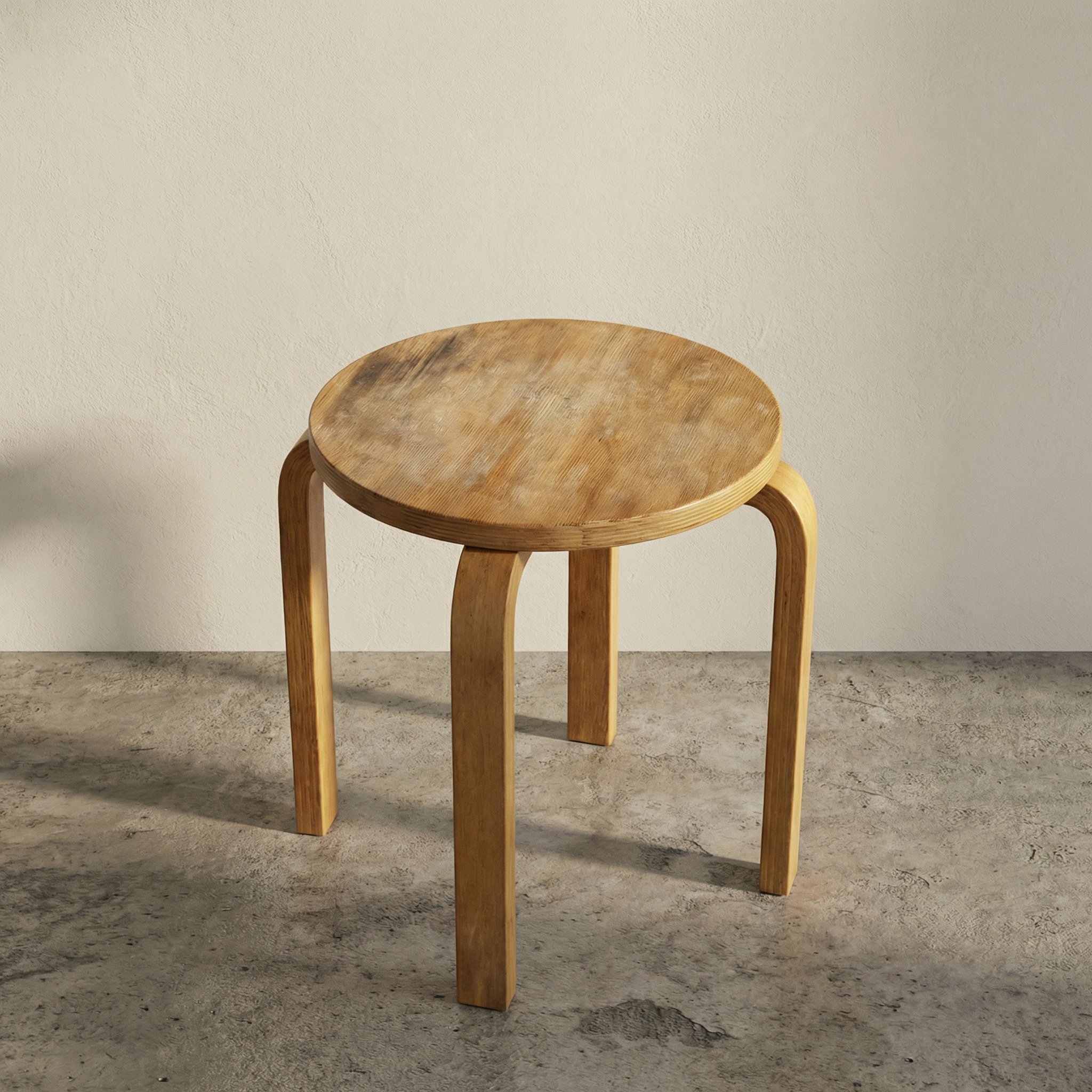
The Story: This is not the Artek original Aalto stool but a vintage mid-century Lithuanian made reproduction, nicely weathered and well made, it not the original but a lovely classic on its own.
….
Alvar Aalto (1898–1976) was a Finnish architect and designer widely regarded as one of the great masters of modernism — though his version of it was distinctly human and organic.
Born in Kuortane, Finland, Aalto studied architecture in Helsinki and launched his career in the 1920s. He initially worked in a classical style before embracing functionalism, but he never let rigid ideology dominate his work. Instead, he believed architecture should serve human wellbeing, incorporating natural materials like wood and brick alongside modern forms.
His breakthrough came with the Paimio Sanatorium (1933) and the Viipuri Library (1935), both celebrated for their thoughtful integration of light, acoustics, and human comfort. Internationally, his Finnish Pavilion at the 1939 New York World's Fair made him a global name.
Beyond buildings, Aalto was a gifted designer — his bent plywood furniture (produced by his company Artek, founded in 1935) and the iconic Savoy vase remain design classics today.
Designer: Sort of Alvar Aalto
The Story: This is not the Artek original Aalto stool but a vintage mid-century Lithuanian made reproduction, nicely weathered and well made, it not the original but a lovely classic on its own.
….
Alvar Aalto (1898–1976) was a Finnish architect and designer widely regarded as one of the great masters of modernism — though his version of it was distinctly human and organic.
Born in Kuortane, Finland, Aalto studied architecture in Helsinki and launched his career in the 1920s. He initially worked in a classical style before embracing functionalism, but he never let rigid ideology dominate his work. Instead, he believed architecture should serve human wellbeing, incorporating natural materials like wood and brick alongside modern forms.
His breakthrough came with the Paimio Sanatorium (1933) and the Viipuri Library (1935), both celebrated for their thoughtful integration of light, acoustics, and human comfort. Internationally, his Finnish Pavilion at the 1939 New York World's Fair made him a global name.
Beyond buildings, Aalto was a gifted designer — his bent plywood furniture (produced by his company Artek, founded in 1935) and the iconic Savoy vase remain design classics today.